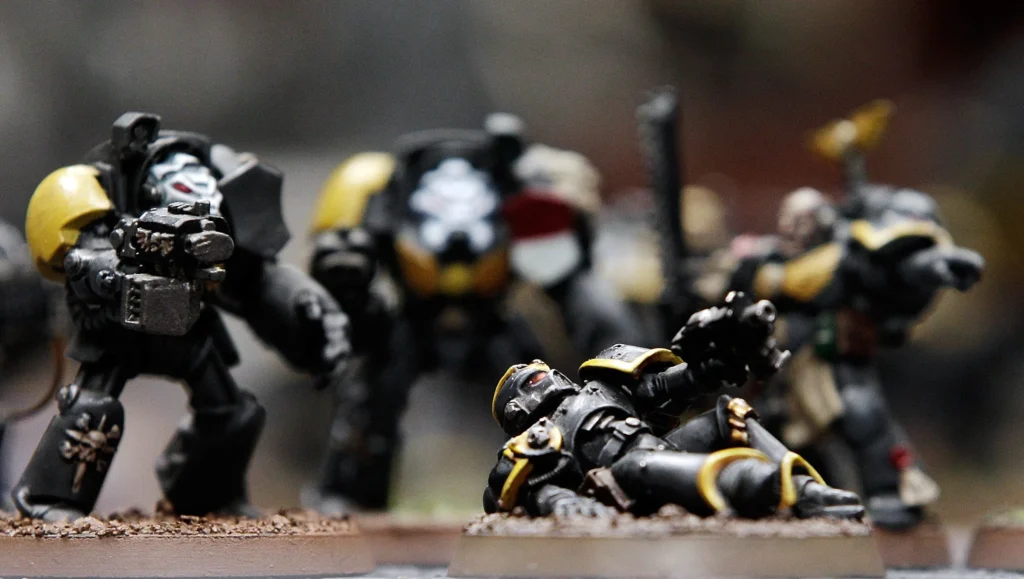
If you follow tabletop gaming or FTSE-market stocks, recent headlines regarding Warhammer 40,000 parent Games Workshop might have caught your attention.
Despite reporting record-breaking annual profits, the company’s share price has experienced a notable pull-back over the past six months, erasing hundreds of millions in market cap. This sharp contrast—soaring bottom-line earnings paired with falling share prices—has left hobbyists and investors asking: Is the miniature giant facing genuine structural trouble, or is the market overreacting?
Here is my breakdown of what is actually happening behind the scenes, the mechanics of short-seller reports, and where the Warhammer IP is heading next.
1. The Core Pressure Points: Rising Costs & Retail Slowdowns
While Games Workshop continues to generate impressive cash flow, institutional investors are looking ahead at systemic margin pressures:
- Escalating Overhead: Rising logistics expenses, international tariff headwinds, and raw material cost spikes (particularly plastics) are compressing manufacturing margins.
- Single-Store Growth Moderation: Financial analyses highlight that samestore retail growth slowed significantly in the second half of the fiscal year—marking the first negative organic growth trend in owned retail locations since the pandemic era.
- Product Saturation Concerns: Frequent, high-priced release cycles for flagship editions have sparked community debate over player fatigue and market saturation. In a tight macroeconomic climate, discretionary consumer spending on premium hobby goods naturally faces closer household scrutiny.
2. The Short-Seller Catalyst: The “Dragoneye” Mystery
The recent drop in valuation was accelerated by a leaked report from Dragoneye, a research firm specializing in short positions.
- Market Reaction: Reports of the confidential document triggered a swift sell-off, shaving roughly £480 million (~$635 million) off Games Workshop’s market cap as cautious investors de-risked their positions.
- Understanding Short Thesis Context: It is vital to evaluate short reports with proper context. These documents are designed to highlight downside scenarios—in this case, pointing out potential growth plateaus and valuation sensitivity.
- Corporate Guidance Alignment: Despite the market noise, Games Workshop’s official trading updates remain strictly in line with board expectations for the current fiscal year.
Blogger’s Analysis: A Valuation Reset, Not a Crashing Business
To understand why the stock dipped despite record profits, you have to look at valuation multiples, not just net revenue.
Blogger’s Take: *Games Workshop has been one of the most lucrative stocks in UK market history over the last decade. However, when a stock trades at a premium valuation (often over 25x earnings), the market demands flawless, uninterrupted growth across every channel.
The moment single-store growth cools off—even slightly—investors re-evaluate the stock’s price tag. What we are seeing isn’t an operational collapse; it’s a standard valuation reset. The fundamental business model remains an absolute money-printing machine with zero meaningful debt burden.*
3. The Bigger Picture: Entertainment IP as the Next Horizon
While physical tabletop sales navigate macroeconomic headwinds, Games Workshop’s long-term enterprise value is increasingly anchored to intellectual property licensing:
- AAA Gaming Pipeline: Major upcoming video game titles—including massive strategy adaptations and high-budget action sequels—continue to expand the IP beyond core tabletop hobbyists.
- Hollywood Media Expansion: High-profile streaming and film deals (including Henry Cavill’s flagship Warhammer 40,000 cinematic universe project) offer vast, high-margin licensing potential over the coming years.
Key Takeaways for Investors & Hobbyists
- The Business Is Profit-Healthy: Record profits and strong cash conversion prove that core demand for Warhammer remains robust.
- Valuation Caution: High-multiple growth stocks are uniquely vulnerable to macro cost spikes and short-seller narratives.
- IP Moat Is Expanding: The transition from a pure tabletop manufacturer to a global entertainment brand provides a long-term commercial cushion.
Do you think tabletop spending is cooling down due to price fatigue, or will upcoming video games and TV adaptations drive the next massive growth wave?